Recovery Proyek Renovasi yang Mangkrak

Baru aja kemarin selesai melakukan renovasi rumah tinggal, dan mungkin melewati salah satu proses yang paling bikin sakit kepala karena kebanyakan drama. Dan semua berawal dari memilih kontraktor yang kurang tepat.

Dan seperti hal-nya project management IT, recovery proyek konstruksi bisa jadi tidak jauh berbeda. Kita akan fokus ke 3 hal yang paling penting yaitu Budget, Timeline, dan Output. Tapi sebelum kita fokus ke recovery, ada baiknya kita fokus dulu ke kontraktor sebelumnya yang pekerjaannya tidak maksimal.

Seperti yang sudah ditulis di post sebelumnya, kontraktor bangunan gw menghilang begitu saja tanpa kabar sama sekali. Meninggalkan banyak pekerjaan yang belum selesai, tanpa sama sekali menunjukkan itikad baik.

Oleh karena itu selain fokus ke recovery, gw juga fokus ke konsekuensi untuk kontraktor supaya ada efek jera dan tidak mengulangi kesalahan yang sama lagi untuk customer yang lain.

Okay lanjut, terkait budgeting tentunya lumayan bikin kepala pusing karena sekarang harus mikirin budget buat melanjutkan pekerjaan dari kontraktor. Dan pertama yang gw lakukan adalah inventarisasi apa pekerjaan yang sudah selesai, yang selesai namun tidak sempurna, dan apa yang sama sekali belum dilakukan oleh kontraktor sebelumnya.

Setelah selesai inventarisasi, selanjutnya adalah cari kontraktor baru atau pekerja bangunan (tukang) yang terpercaya dan bisa diandalkan untuk melanjutkan pekerjaan ini. Untungnya gw punya kenalan tukang harian yang sudah lama bantu di rumah gw. Gw minta beliau untuk melanjutkan pekerjaan yang berantakan, sekaligus minta hitung estimasi budget berapa. Budgeting menjadi sangat dinamis karena banyak pekerjaan yang harus dilakukan dan dengan rate tukang yang harian. Selain dari budgeting tukang, yang harus dihitung juga adalah budgeting untuk material. Terutama untuk pekerjaan finishing seperti granite lantai dan kitchen set.

Estimasi timeline juga perlu dilakukan untuk menghitung berapa lama waktu yang dibutuhkan untuk menyelesaikan pekerjaan yang ditinggalkan oleh kontraktor. Dari estimasi awal, kontraktor untuk butuh waktu 2 bulan untuk mengerjakan pekerjaan sesuai dengan kontrak yang sudah disepakati. Namun karena kontraktor menghilang begitu saja, timeline pekerjaan bisa jadi molor sangat jauh dari rencana awal. Sehingga dari rencana awal 2 bulan, bisa molor menjadi 9 bulan hahaa.

Untuk output pekerjaan juga menjadi sangat melebar, apalagi dikarenakan banyak referensi dari Instagram dan banyak inspirasi karena sering jalan-jalan ke toko bahan bangunan. Yang tadinya renovasi sederhana untuk 1 lantai saja, bisa berubah menjadi renovasi total semua bagian rumah. Namun pastikan juga bahwa pekerjaan yang diinginkan, sesuai dengan budget dan timeline yang dimiliki.

Overall, budget dan timeline untuk recovery dan finishing malah lebih besar daripada budget dan timeline yang yang diestimasikan oleh kontraktor sebelumnya. Contohnya adalah budget untuk finishing ternyata bisa hampir dua kali lipat dibandingkan budget struktur fisik, itu pun belum menghitung biaya untuk furniture dan peralatan elektronik lain seperti AC atau Kulkas.

Kesimpulan.
Always have backup plan, and backup plan for your backup plan. Selalu miliki cadangan budget yang bisa digunakan apabila terjadi “force majeur” atau kendala ketika implementasi, serta spare waktu yang agak lumayan. Apalagi jika bekerjasama dengan kontraktor yang belum punya nama atau reputasi. Usahakan juga untuk punya “advisor” atau orang yang bisa dipercaya untuk mengawal jalannya project, terutama apabila memiliki limitasi knowledge tentang konstruksi.

Deploying Python App using S2I to Openshift Container Platform

For this sample, we are trying to deploy a Flask application to Openshift without any CI/CD tools involved. Means we are deploying directly by using S2I functionality thru OCP Dashboard.

Lets start with a simple hello world Python application, it is basically one simple py file

from flask import Flask

app = Flask(__name__)

@app.route("/")
def index():
    return "<h1>Hello, World!</h1>"

app.run(host="0.0.0.0", port=8080)

and one requirements.txt file,

flask

And after that, we can push our complete Python code to a Git repository. For example, im using below Git repo,

https://github.com/edwin/hello-world-flask

We can deploy to Openshift from the Developer dashboard,

Put the Git repo URL there

It will trigger a build process

Would took a while

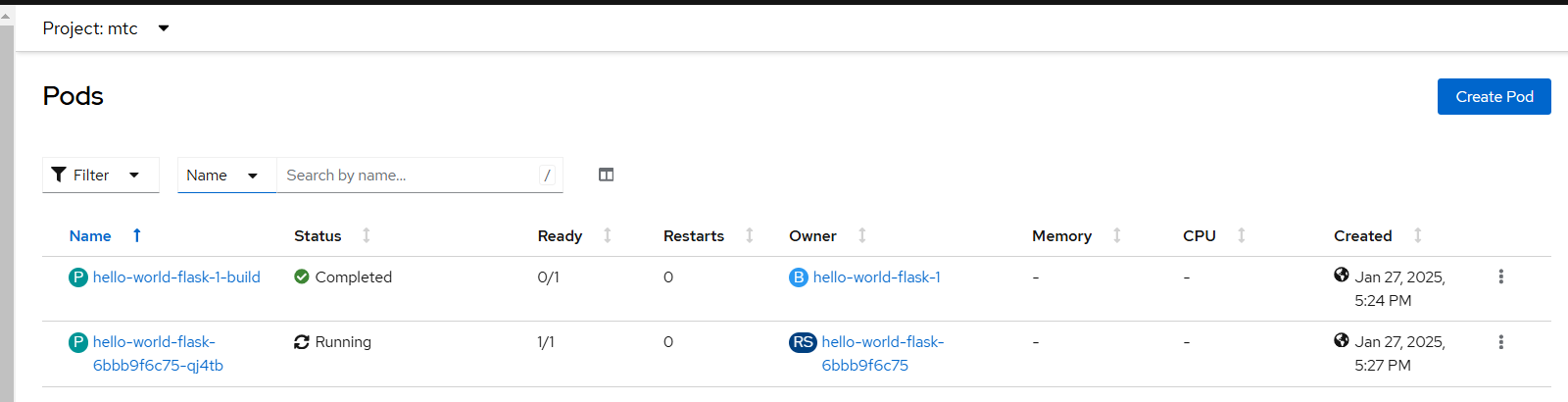
But it will deployed successfully after a while

We can access the deployed apps directly after we expose a Route to our app.

Build a Native Quarkus and Camel Application using Mandrel and Docker

Apache Camel is a Java framework for routing and integration, and when we talk about integration means we are talking about lightweight and fast response time. And this is where Apache Camel and Quarkus comes into the picture.

Utilizing Quarkus capability of native compilation, we can compile our Camel Framework application into a native application without the necessity of using JVM. Therefore making a lightweight Apache Camel into more lighweight and faster.

For this project, we will start with a simple Maven file

<?xml version="1.0" encoding="UTF-8"?>
<project xmlns="http://maven.apache.org/POM/4.0.0"
         xmlns:xsi="http://www.w3.org/2001/XMLSchema-instance"
         xsi:schemaLocation="http://maven.apache.org/POM/4.0.0 http://maven.apache.org/xsd/maven-4.0.0.xsd">
    <modelVersion>4.0.0</modelVersion>

    <groupId>com.edw</groupId>
    <artifactId>quarkus-camel-native</artifactId>
    <version>1.0-SNAPSHOT</version>

    <properties>
        <compiler-plugin.version>3.13.0</compiler-plugin.version>
        <maven.compiler.release>21</maven.compiler.release>
        <project.build.sourceEncoding>UTF-8</project.build.sourceEncoding>
        <project.reporting.outputEncoding>UTF-8</project.reporting.outputEncoding>
        <quarkus.platform.artifact-id>quarkus-bom</quarkus.platform.artifact-id>
        <quarkus.platform.group-id>io.quarkus.platform</quarkus.platform.group-id>
        <quarkus.platform.version>3.16.3</quarkus.platform.version>
        <skipITs>true</skipITs>
        <surefire-plugin.version>3.5.0</surefire-plugin.version>
    </properties>

    <dependencyManagement>
        <dependencies>
            <dependency>
                <groupId>${quarkus.platform.group-id}</groupId>
                <artifactId>${quarkus.platform.artifact-id}</artifactId>
                <version>${quarkus.platform.version}</version>
                <type>pom</type>
                <scope>import</scope>
            </dependency>
            <dependency>
                <groupId>${quarkus.platform.group-id}</groupId>
                <artifactId>quarkus-camel-bom</artifactId>
                <version>${quarkus.platform.version}</version>
                <type>pom</type>
                <scope>import</scope>
            </dependency>
        </dependencies>
    </dependencyManagement>

    <dependencies>
        <dependency>
            <groupId>org.apache.camel.quarkus</groupId>
            <artifactId>camel-quarkus-direct</artifactId>
        </dependency>
        <dependency>
            <groupId>org.apache.camel.quarkus</groupId>
            <artifactId>camel-quarkus-jackson</artifactId>
        </dependency>
        <dependency>
            <groupId>org.apache.camel.quarkus</groupId>
            <artifactId>camel-quarkus-rest</artifactId>
        </dependency>
        <dependency>
            <groupId>io.quarkus</groupId>
            <artifactId>quarkus-arc</artifactId>
        </dependency>
        <dependency>
            <groupId>io.quarkus</groupId>
            <artifactId>quarkus-junit5</artifactId>
            <scope>test</scope>
        </dependency>
    </dependencies>

    <build>
        <plugins>
            <plugin>
                <groupId>${quarkus.platform.group-id}</groupId>
                <artifactId>quarkus-maven-plugin</artifactId>
                <version>${quarkus.platform.version}</version>
                <extensions>true</extensions>
                <executions>
                    <execution>
                        <goals>
                            <goal>build</goal>
                            <goal>generate-code</goal>
                            <goal>generate-code-tests</goal>
                            <goal>native-image-agent</goal>
                        </goals>
                    </execution>
                </executions>
            </plugin>
            <plugin>
                <artifactId>maven-compiler-plugin</artifactId>
                <version>${compiler-plugin.version}</version>
                <configuration>
                    <parameters>true</parameters>
                </configuration>
            </plugin>
            <plugin>
                <artifactId>maven-surefire-plugin</artifactId>
                <version>${surefire-plugin.version}</version>
                <configuration>
                    <systemPropertyVariables>
                        <java.util.logging.manager>org.jboss.logmanager.LogManager</java.util.logging.manager>
                        <maven.home>${maven.home}</maven.home>
                    </systemPropertyVariables>
                </configuration>
            </plugin>
            <plugin>
                <artifactId>maven-failsafe-plugin</artifactId>
                <version>${surefire-plugin.version}</version>
                <executions>
                    <execution>
                        <goals>
                            <goal>integration-test</goal>
                            <goal>verify</goal>
                        </goals>
                    </execution>
                </executions>
                <configuration>
                    <systemPropertyVariables>
                        <native.image.path>${project.build.directory}/${project.build.finalName}-runner</native.image.path>
                        <java.util.logging.manager>org.jboss.logmanager.LogManager</java.util.logging.manager>
                        <maven.home>${maven.home}</maven.home>
                    </systemPropertyVariables>
                </configuration>
            </plugin>
        </plugins>
    </build>

    <profiles>
        <profile>
            <id>native</id>
            <activation>
                <property>
                    <name>native</name>
                </property>
            </activation>
            <properties>
                <skipITs>false</skipITs>
                <quarkus.native.enabled>true</quarkus.native.enabled>
            </properties>
        </profile>
    </profiles>

</project>

a properties file,

# default
quarkus.http.port=8080
quarkus.log.level=INFO
quarkus.log.category."com.edw".level=DEBUG

quarkus.log.console.format=%d{yyyy-MM-dd HH:mm:ss,SSS} %h %N[%i] %-5p [%c{3.}] (%t) %s%e%n

# disable sending anonymous statistics
quarkus.analytics.disabled=true

and with a simple Java file,

package com.edw.route;

import jakarta.enterprise.context.ApplicationScoped;
import org.apache.camel.builder.RouteBuilder;

@ApplicationScoped
public class HelloWorldRoute extends RouteBuilder {

    @Override
    public void configure() throws Exception {
        rest("/api")
                .get("/hello-world")
                .produces("application/json")
                .to("direct:hello-world");

        from("direct:hello-world")
                .routeId("hello-world-api")
                .log("calling getHelloWorld")
                .setBody(constant("{\"hello\":\"world\"}"));
    }
}

and finally, a Dockerfile

## Stage 1 : build with maven builder image with native capabilities
FROM quay.io/quarkus/ubi-quarkus-mandrel-builder-image:jdk-21 AS build
COPY --chown=quarkus:quarkus --chmod=0755 mvnw /code/mvnw
COPY --chown=quarkus:quarkus .mvn /code/.mvn
COPY --chown=quarkus:quarkus pom.xml /code/
USER quarkus
WORKDIR /code
RUN ./mvnw -B org.apache.maven.plugins:maven-dependency-plugin:3.1.2:go-offline
COPY src /code/src
RUN ./mvnw package -Dnative

## Stage 2 : create the docker final image
FROM quay.io/quarkus/quarkus-micro-image:2.0
WORKDIR /work/
COPY --from=build /code/target/*-runner /work/application

# set up permissions for user `1001`
RUN chmod 775 /work /work/application \
  && chown -R 1001 /work \
  && chmod -R "g+rwX" /work \
  && chown -R 1001:root /work

EXPOSE 8080
USER 1001

CMD ["./application", "-Dquarkus.http.host=0.0.0.0"]

As we can see, it is a multi-stage docker build and we are using Mandrel to compile Quarkus into a native application. Next is to do a docker build, and see our Quarkus add compiled into native

$ podman build -t quarkus-camel-native -f multistage.dockerfile  .

[1/8] Initializing...                                                                                   (11.5s @ 0.12GB)
 Java version: 21.0.5+11-LTS, vendor version: Mandrel-23.1.5.0-Final
 Graal compiler: optimization level: 2, target machine: x86-64-v3
 C compiler: gcc (redhat, x86_64, 8.5.0)
 Garbage collector: Serial GC (max heap size: 80% of RAM)
 4 user-specific feature(s):
 - com.oracle.svm.thirdparty.gson.GsonFeature
 - io.quarkus.runner.Feature: Auto-generated class by Quarkus from the existing extensions
 - io.quarkus.runtime.graal.DisableLoggingFeature: Disables INFO logging during the analysis phase
 - org.eclipse.angus.activation.nativeimage.AngusActivationFeature
 
 .......
 
Produced artifacts:
 /code/target/quarkus-camel-native-1.0-SNAPSHOT-native-image-source-jar/build-artifacts.json (build_info)
 /code/target/quarkus-camel-native-1.0-SNAPSHOT-native-image-source-jar/quarkus-camel-native-1.0-SNAPSHOT-runner (executable)
 /code/target/quarkus-camel-native-1.0-SNAPSHOT-native-image-source-jar/quarkus-camel-native-1.0-SNAPSHOT-runner-build-output-stats.json (build_info)
========================================================================================================================
Finished generating 'quarkus-camel-native-1.0-SNAPSHOT-runner' in 3m 24s.

We can gain some benefits from native compilation such as a lighter image and less utilization

$ podman stats -a
ID            NAME               CPU %       MEM USAGE / LIMIT  MEM %       NET IO      BLOCK IO      PIDS        CPU TIME    AVG CPU %
f8745a7b7ce2  gracious_goldberg  0.01%       37.86MB / 4.097GB  0.92%       0B / 0B     0B / 12.29kB  12          1.155723s   0.41%

Code for this activity can be found here,

https://github.com/edwin/quarkus-camel-native

How to Fix Jenkins “No such DSL method ‘node’ found among steps”

Had this error today,

Also:   org.jenkinsci.plugins.workflow.actions.ErrorAction$ErrorId: 417038a0-74ea-4878-a8b3-6a832a793150
java.lang.NoSuchMethodError: No such DSL method 'node' found among steps [archive, bat, build, catchError, checkout, container,
 containerLog, deleteDir, dir, echo, envVarsForTool, error, fileExists, getContext, git, input, isUnix, library, libraryResource, load,
 mail, milestone, node, parallel, podTemplate, powershell, properties, pwd, pwsh, readFile, readTrusted, resolveScm, retry, script, sh,
 sleep, stage, stash, step, timeout, tool, unarchive, unstable, unstash, validateDeclarativePipeline, waitForBuild, waitUntil, warnError,
 withContext, withCredentials, withEnv, wrap, writeFile, ws] or symbols [GitUsernamePassword, agent, all, allBranchesSame, allOf, always,
 any, anyOf, apiToken, apiTokenProperty, architecture, archiveArtifacts, artifactManager, assembla, authorInChangelog, batchFile,
 bitbucket, bitbucketServer, booleanParam, branch, browser, buildButton, buildDiscarder, buildDiscarders, buildRetention,
 buildSingleRevisionOnly, buildingTag, builtInNode, caseInsensitive, caseSensitive, certificate, cgit, changeRequest, changelog,
 changelogBase, changelogToBranch, changeset, checkoutOption, checkoutToSubdirectory, choice, choiceParam, cleanAfterCheckout,
 cleanBeforeCheckout, clock, cloneOption, command, computerRetentionCheckInterval, configMapVolume, consoleUrlProvider, containerEnvVar,
 containerLivenessProbe, containerTemplate, cps, credentials, cron, crumb, default, defaultDisplayUrlProvider, defaultFolderConfiguration, 
defaultView, demand, disableConcurrentBuilds, disableRestartFromStage, disableResume, discoverOtherRefs, discoverOtherRefsTrait, diskSpace, diskSpaceMonitor, downstream, dumb, durabilityHint, dynamicPVC, emptyDirVolume, emptyDirWorkspaceVolume, envVar, envVars, envVarsFilter, 
environment, equals, experimentalFlags, expression, file, fileParam, filePath, fingerprint, fingerprints, firstBuildChangelog, fisheye, 
frameOptions, freeStyle, freeStyleJob, fromScm, fromSource, genericEphemeralVolume, git, gitBranchDiscovery, gitHooks, gitLab, gitList, 
gitSCM, gitTagDiscovery, gitTool, gitUsernamePassword, gitWeb, gitblit, github, gitiles, gogs, headRegexFilter, headWildcardFilter, 
hostPathVolume, hostPathWorkspaceVolume, hyperlink, hyperlinkToModels, ignoreOnPush, inbound, installSource, isRestartedRun, jdk, jgit,
 jgitapache, jnlp, jobBuildDiscarder, jobName, kiln, kubeconfig, kubernetes, kubernetesAgent, label, lastDuration, lastFailure, 
lastGrantedAuthorities, lastStable, lastSuccess, legacy, legacySCM, lfs, list, local, localBranch, localBranchTrait, location, logRotator,
 loggedInUsersCanDoAnything, mailer, masterBuild, maven, maven3Mojos, mavenErrors, mavenGlobalConfig, mavenMojos, mavenWarnings, merge, 
modernSCM, multiBranchProjectDisplayNaming, multibranch, myView, namedBranchesDifferent, never, nfsVolume, nfsWorkspaceVolume, node, 
nodeProperties, none, nonresumable, not, onFailure, organizationFolder, override, overrideIndexTriggers, paneStatus, 
parallelsAlwaysFailFast, parameters, password, pattern, perBuildTag, permanent, persistentVolumeClaim, 
persistentVolumeClaimWorkspaceVolume, phabricator, pipeline, pipelineTriggers, plainText, plugin, podAnnotation, podEnvVar, podLabel, 
pollSCM, portMapping, preserveStashes, prism, projectNamingStrategy, proxy, pruneStaleBranch, pruneStaleTag, pruneTags, 
queueItemAuthenticator, quietPeriod, rateLimit, rateLimitBuilds, redmine, refSpecs, remoteName, resourceRoot, responseTime, 
retainOnlyVariables, rhodeCode, run, runParam, schedule, scmGit, scmRetryCount, scriptApproval, scriptApprovalLink, search, secretEnvVar, 
secretVolume, security, shell, simpleBuildDiscarder, skipDefaultCheckout, skipStagesAfterUnstable, slave, sourceRegexFilter, 
sourceWildcardFilter, sparseCheckout, sparseCheckoutPaths, sshUserPrivateKey, standard, status, string, stringParam, submodule, 
submoduleOption, suppressAutomaticTriggering, suppressFolderAutomaticTriggering, swapSpace, tag, teamFoundation, text, textParam, timezone, 
tmpSpace, toolLocation, triggeredBy, unsecured, untrusted, upstream, userIdentity, userSeed, usernameColonPassword, usernamePassword, 
viewgit, viewsTabBar, weather, zip] or globals [currentBuild, env, params, pipeline, scm]
	at PluginClassLoader for workflow-cps//org.jenkinsci.plugins.workflow.cps.DSL.invokeMethod(DSL.java:219)
	at PluginClassLoader for workflow-cps//org.jenkinsci.plugins.workflow.cps.CpsScript.invokeMethod(CpsScript.java:124)
	at java.base/jdk.internal.reflect.NativeMethodAccessorImpl.invoke0(Native Method)
	at java.base/jdk.internal.reflect.NativeMethodAccessorImpl.invoke(Unknown Source)
	at java.base/jdk.internal.reflect.DelegatingMethodAccessorImpl.invoke(Unknown Source)
	at java.base/java.lang.reflect.Method.invoke(Unknown Source)
	at org.codehaus.groovy.reflection.CachedMethod.invoke(CachedMethod.java:98)
	at groovy.lang.MetaMethod.doMethodInvoke(MetaMethod.java:325)
	at groovy.lang.MetaClassImpl.invokeMethod(MetaClassImpl.java:1225)
	at groovy.lang.MetaClassImpl.invokeMethod(MetaClassImpl.java:1034)
	at org.codehaus.groovy.runtime.callsite.PogoMetaClassSite.call(PogoMetaClassSite.java:41)
	at org.codehaus.groovy.runtime.callsite.CallSiteArray.defaultCall(CallSiteArray.java:47)
	at org.codehaus.groovy.runtime.callsite.AbstractCallSite.call(AbstractCallSite.java:116)
	at PluginClassLoader for script-security//org.kohsuke.groovy.sandbox.impl.Checker$1.call(Checker.java:180)
	at PluginClassLoader for script-security//org.kohsuke.groovy.sandbox.GroovyInterceptor.onMethodCall(GroovyInterceptor.java:23)
	at PluginClassLoader for script-security//org.jenkinsci.plugins.scriptsecurity.sandbox.groovy.SandboxInterceptor.onMethodCall(SandboxInterceptor.java:163)

when building Jenkins Pipeline using Script from SCM. The weird thing is the same script is working perfectly well when being executed directly from Jenkins, without the SCM / Git part.

The rootcause is actually simple, we are storing the Jenkins pipeline in Git using UTF8 With BOM with a specific Windows encoding. Saving it as a UTF8 directy and push it to Git can solve this problem.

ps.
opening the log in notepad++, after choosing the option to show all character, will give this result.

As we can see from above image, there is a “hidden” character with the name of “ZWNBSP” that is invisible to naked eyes. However it makes Jenkins failed to parse the corresponding pipeline.

How to Solve “error, cannot create resource in API group” when Deploying Application with Jenkins and OpenShift

Had this error when im using Jenkins and integrate it to Openshift Container Platform

--> Creating resources with label build=hello-world-dot-net-core ...
    error: imagestreams.image.openshift.io is forbidden: User "system:serviceaccount:cicd:default" cannot create resource "imagestreams" in API group "image.openshift.io" in the namespace "cicd"
    error: buildconfigs.build.openshift.io is forbidden: User "system:serviceaccount:cicd:default" cannot create resource "buildconfigs" in API group "build.openshift.io" in the namespace "cicd"
--> Failed

How to solve this issue is actually quite simple, running this below command can solve it directly.

$ oc policy add-role-to-user admin system:serviceaccount:cicd:default -n cicd