utility

How to Create A HTTP Request with Proxy Using Apache HTTP Client

In this tutorial, im trying to simuate a http GET request using apache http client, the version im using is 4.5.1

<!-- http client -->
<dependency>
	<groupId>org.apache.httpcomponents</groupId>
	<artifactId>httpclient</artifactId>
	<version>4.5.1</version>
</dependency>
<dependency>
	<groupId>org.apache.httpcomponents</groupId>
	<artifactId>httpmime</artifactId>
	<version>4.5.1</version>
</dependency>

Usually, my application connects well without proxy. But on production environment, I need to put a proxy configuration. So this is my method for making a proxy request connection.

public String process(String lat, String lon) {
	try {
		HttpClient httpclient = HttpClientBuilder.create().build();
		HttpGet httpGet = new HttpGet("<INPUT YOUR URL HERE>");
		
		HttpHost proxy = new HttpHost("127.0.0.1", 3128, "http");
		RequestConfig config = RequestConfig.custom()
				.setProxy(proxy)
				.build();
		httpGet.setConfig(config);
		
		HttpResponse response = httpclient.execute(httpGet);
		HttpEntity resEntity = response.getEntity();

		String responseText = EntityUtils.toString(resEntity);		
		return responseText;
	} catch (IOException e) {
		logger.error(e, e);
	} catch (Exception e) {
		logger.error(e, e);
	}
	return null;
}

Weird Error on Java Mail, “javax.mail.AuthenticationFailedException: No authentication mechansims supported by both server and client”

I run into a weird error that never happened before, somehow it happened since my user upgrade their Microsoft Mail Exchange’s version. Here is the complete stacktrace,

Caused by: javax.mail.AuthenticationFailedException: 
No authentication mechansims supported by both server and client
    at com.sun.mail.smtp.SMTPTransport.authenticate(SMTPTransport.java:760)
    at com.sun.mail.smtp.SMTPTransport.protocolConnect(SMTPTransport.java:673)
    at javax.mail.Service.connect(Service.java:317)

I guess there are several reasons why it happens. First of all, it happens because im using starttls = “true” despite im connecting to port 25, first i change it into “false”. And the other thing is that im using username and password for connecting to my email exchange server, so the workaround is quite easy, just setting my mail.smtp.auth parameter into “false” instead of “true”. Or try sending email without setting username and password.

But actually, it’s much easier to fix the error on the mail server’s side, because it’s only a simple checklist configuration 😛

How to Perform “Autopsy” on OutOfMemoryError Application

Just several days ago, my application was down because of OutOfMemoryError, and I haven’t got a clue what the root cause is. That’s why I’m looking for a way on how to find the culprit when my application is down again. So im using this jvm parameter to dump all the object on memory when OutOfMemoryError happen.

-XX:+HeapDumpOnOutOfMemoryError -XX:HeapDumpPath=E:\ -Xmx10m -Xms10m

For example, im using this java class to simulate OutOfMemoryError,

package mybatistesting;

import java.util.ArrayList;
import java.util.List;

public class MyBatisTesting {
    
    public static void main(String[] args) throws Exception {
        List list = new ArrayList();
        for (int i = 0; i < 10000000000l; i++) {
            list.add(i+""+i+""+i);
            if(i%1000==0)
                System.out.println("adding -- "+i);
        }
    }
}

As you can see on your console log,

java.lang.OutOfMemoryError: GC overhead limit exceeded
Dumping heap to E:\java_pid5812.hprof ...
Heap dump file created [15155736 bytes in 0.237 secs]

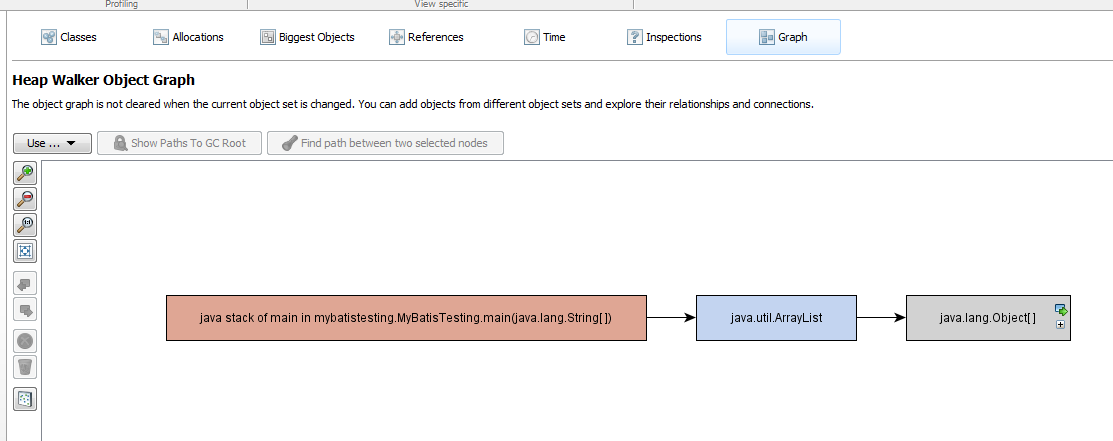
You can open java_pid5812.hprof using your preferable application, for example using Eclipse MAT or JProfiler.

eclipse mat

jprofiler 1

jprofiler 2

Have fun 😉

How to Simulate and Finding Connection Leak in Oracle

It’s been a while since the last time i’ve write tutorials in my blog, but i found a very interesting case that perhaps helped a lot of people. Today im trying to create a simple test case to simulate a connection leak and how to search for it.

First is creating a simple unclosed connection query using java,

package com.edw;

import java.sql.Connection;
import java.sql.DriverManager;
import java.sql.ResultSet;
import java.sql.Statement;

public class Main {

    public static void main(String[] args) throws Exception {
        System.out.println("starting --------");
        
        Class.forName("oracle.jdbc.driver.OracleDriver");
        Connection connection = DriverManager.getConnection("jdbc:oracle:thin:@localhost:1521:xe", "USERNAME", "password");
        Statement statement = connection.createStatement();
        ResultSet resultSet = statement.executeQuery("SELECT * FROM INVALID"); // example table name is INVALID
        
        while(resultSet.next()) {
            System.out.println(resultSet.getString(1));
            System.out.println(resultSet.getString(2));
            System.out.println(resultSet.getString(3));
            System.out.println("=============");
        }
        
        System.out.println("ending --------");
        
        while(true) {
            Thread.sleep(10000);
            System.out.println("testing --------");
        }
    
    }
}

It will create an unclosed query that will hanging on my oracle connection.
And next, is my oracle query to find the hanging queries,

select LAST_CALL_ET, SQL_TEXT, username, machine, to_char(logon_time, 'ddMon hh24:mi') as login, 
    SQL_HASH_VALUE, PREV_HASH_VALUE, status
from v$session, v$sql 
where username='USERNAME' and HASH_VALUE =  PREV_HASH_VALUE
order by last_call_et desc;

it will show result like this,

LAST_CALL_ET SQL_TEXT                USERNAME     MACHINE        LOGIN                SQL_HASH_VALUE PREV_HASH_VALUE STATUS 
------------ ---------------------- ------------- -------------- -------------------- -------------- --------------- --------
          91 SELECT * FROM INVALID   USERNAME     edw      	     03Mar 11:53                       0       621168917 INACTIVE 

As you can see the result on the first column, “SELECT * FROM INVALID” query has run for more than 90 seconds.
So i can easily find the java class culprit who run that query.

FYI, this is my Oracle version,

select * from v$version;

BANNER                                                                         
--------------------------------------------------------------------------------
Oracle Database 11g Express Edition Release 11.2.0.2.0 - Production              
PL/SQL Release 11.2.0.2.0 - Production                                           
CORE	11.2.0.2.0	Production                                                         
TNS for 32-bit Windows: Version 11.2.0.2.0 - Production                          
NLSRTL Version 11.2.0.2.0 - Production   

I Hope this tutorial can help others, have fun 🙂

java.sql.SQLException: Numeric Overflow When Connecting to Oracle using MyBatis

Im using mybatis framework, and it was working very nice untuil today ive found a very weird error. A very weird error, because im only doing select queries and not insert anything.

This is the complete stacktrace,

Cause: java.sql.SQLException: Numeric Overflow
	at org.apache.ibatis.exceptions.ExceptionFactory.wrapException(ExceptionFactory.java:26)
	at org.apache.ibatis.session.defaults.DefaultSqlSession.selectList(DefaultSqlSession.java:111)
	at org.apache.ibatis.session.defaults.DefaultSqlSession.selectList(DefaultSqlSession.java:102)
	at org.apache.ibatis.binding.MapperMethod.executeForMany(MapperMethod.java:119)
	at org.apache.ibatis.binding.MapperMethod.execute(MapperMethod.java:63)
	at org.apache.ibatis.binding.MapperProxy.invoke(MapperProxy.java:52)
	at com.sun.proxy.$Proxy190.selectByExample(Unknown Source)
Caused by: java.sql.SQLException: Numeric Overflow
	at oracle.jdbc.driver.NumberCommonAccessor.throwOverflow(NumberCommonAccessor.java:4381)
	at oracle.jdbc.driver.NumberCommonAccessor.getShort(NumberCommonAccessor.java:353)
	at oracle.jdbc.driver.OracleResultSetImpl.getShort(OracleResultSetImpl.java:1118)
	at oracle.jdbc.driver.OracleResultSet.getShort(OracleResultSet.java:418)
	at org.apache.tomcat.dbcp.dbcp.DelegatingResultSet.getShort(DelegatingResultSet.java:272)
	at org.apache.tomcat.dbcp.dbcp.DelegatingResultSet.getShort(DelegatingResultSet.java:272)
	at sun.reflect.GeneratedMethodAccessor198.invoke(Unknown Source)
	at sun.reflect.DelegatingMethodAccessorImpl.invoke(DelegatingMethodAccessorImpl.java:43)

This is my java bean,

public class TblInvalid implements Serializable {
    private short id;

    private String attribute7;

    // other setter and getter
}

My Oracle DDL looks like this,

CREATE TABLE TBL_INVALID
    (
        ID NUMBER,
        ATTRIBUTE7 VARCHAR2(255)
 )

The workaround is actually so simple, changing from Short into BigDecimal makes the problem goes away.

public class TblInvalid implements Serializable {
    private BigDecimal id;

    private String attribute7;

    // other setter and getter
}